Saturday, November 27, 2010

Memphis Redux

    
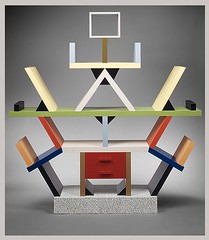
The Carlton Cabinet - Designed by Ettore Sotts...Image by Mario Seekr via Flickr
Bookshelf, Ettore Sottsass, 1981

The holiday season tends to bring out the kid in most people. And when I think of kids and design, I'm most reminded historically of one of design's more unusual and whimsical periods - that of the Memphis style movement.

Primarily begun in the 1980's as a product design statement by a group of avant-garde Italian visionaries, including the acclaimed industrial designer Ettore Sottsass, Memphis style went from being shockingly esoteric to the mode du jour in less than a decade. In doing so, it challenged many of the long-standing rules of design, and brought with it a new era of post-modern experimentation and vitality.

The New York Times documented the beginnings of the movement in a related MoMA exhibit review a few years back:

Typwriter, (Valentine), Sottsass, 196
"Memphis was cooked up in Ettore Sottsass's Milan apartment one night in December 1980, when the host, then in his sixties and a grandee of Italian design, invited a group of younger designers to develop a furniture collection to show at the following year's Milan Furniture Fair. It was to be a protest against the dry modernist style that had dominated design for decades, and they called it "Memphis" because Bob Dylan's "Stuck Inside of Mobile with the Memphis Blues Again" was on the record player, and the needle kept sticking (a common problem back in ye olden days of the 1980s) on the last three words of the title."

Some say that Memphis design also put an imaginative spin on Art Deco style of the 1920's, the later of which derived much of its initial influence from Egyptian motifs made popular at the time by the discovery of King Tutankhamen's tomb. Hence, the name may play on that foundation as well.

Whatever the case, the movement's bold use of bright primary colors and expressive zig-zag patterns seeped into everyday 1980's fashion and can be traced essentially to Sottsass's vision. The colorful triangular shapes on the pop singer El Debarge's jackets, or the the striking yellow outfits Mick Jagger wore at the time come forefront to memory. The movie Ruthless People, with Jagger's voice commanding the animated intro, gives one a good glimpse of the true playfulness of the style, as shown in the clip below:


But it was more than just color and wit that comprised the sensibilities inherent in Memphis design. There was a clear repudiation of standard assumptions of proportion and shape that stretched a new canvas for creative possibilities. Many of these overturned notions are present in product designs of items such as Apple computers and iPods, giving them an almost perennially futuristic appearance.

Sottsass also experimented heavily on a "utopian" concept of living space. He was an opinionated anti-consumerist, declaring at one point that "I didn’t want to do any more consumerist products, because it was clear that the consumerist attitude was quite dangerous."


"Living Environment" Exhibit, 1972.

Thus he often detoured from furniture design to explore concepts of interior and architecture. His forward-minded "Living Environment" exhibit, consisted of a series of nine compact, modular living compartments, each meant to be easily personalized and pleasant. One compartment contained a kitchen, another a seat/bed, a wardrobe, a toilet, a desk system and even a jukebox. His compartments were all connected to provide water and electricity to each unit.

As we move along into the twenty-first century, our living space is shrinking. In big cities such as Tokyo and Shanghai, his concepts already exist. At the rate we are depleting natural resources and contaminating the earth environment, there may well be a need for all of humanity to live in separate, small, sealed rooms that share power and water.

Totem Vase.
But in terms of mere aesthetics, some claim that we are in the midst of a Memphis style renaissance. As stated nicely by the Times reviewer, recent style is "rebelling against the slickness of megabranding to chase the 'emotional and expressive' qualities in the original Memphis pieces," and design also seems to be "searching for alternatives to the delicate neo-romantic style, which was fashionable in the early 2000s." What could be more suited for that than a reinterpretation of kitschy, flashy Memphis?

Love it or hate it, Memphis style remains one of the more peculiar and startling moments in design history. It was an eruption of modernity, as if modern style were looking back and re-imagining itself as a vibrant, amusing, radical, self-aware, contemplative other face. And as Sottsass said in a 1986 Chicago Tribune interview, "Memphis is like a very strong drug. You cannot take too much. I don't think anyone should put only Memphis around - it's like eating only cake."--D.A. DeMers.


For helpful information about weatherization and home energy issues, please visit our sister site Home Science. Plus, stay updated with tons of fun posts on art, design, and sustainability, by hitting the Tumblr and Twitter buttons above.
Enhanced by Zemanta

Tuesday, November 9, 2010

The Origins of Flight

A young man's unlikely ascent into the world of design   
           
Image via Wikipedia
Not long ago I was looking through an old magazine and out plopped some photos of lamps I thought were long lost. There's a story linked to them worth telling, so here goes...
              
Wicker Park Chicago in the 90's was not unlike Greenwich Village in the 60's. The cafes, lounges, and parties resonated with the constant chatter of creative ideas. Music, art, literature, and youth culture had converged on this locale, and in the air was a tremendous zeitgeist shared by everyone, a sense that something quite amazing was happening...and things did.
   
That's all over now. And I have exiled myself to Philly, where that same spirit of creativity is beginning to burn brightly (and likewise so does the spirit of championship baseball team). Wicker Park now seems nothing but a faraway planet of unauthentic-looking chain bars, ubiquitous trendy restaurants, and stretches of hastily slapped together yuppie condos. Dorothy Parker's famous quote is fitting: "there's no there there."
 
But for one particular moment in time, it was a special place. And being one who experienced the apex of that moment, I was motivated to do many artistic endeavors. Playing music and being in a variety of bands was one, but more offbeat, perhaps, was the compulsion to make things, especially lamps.
    
It started with an odd curiosity and study of the "birdmen" who built flying machines in the early 1900s. They seemed particularly fascinating, since many of them had no prior experience with such engineering, yet risked death to see if their contraptions would succeed. The human desire to fly is a legacy steeped in mythology, linked back to humankind's first ambitions. It's the consummate metaphor for freedom on many levels - the dream to defy the shackles of gravity, whatever that may represent...I often felt that gravity profoundly.
   
When electricity became usable to consumers, many designers, engineers, and architects found an alluring new technology with which to work. From the Arts and Crafts era to Art Deco, a plethora of imaginative lighting designs were created, designs that greatly influenced my flight into this enticing realm.
   
The French-based Desny design group and lamp artists such as Kola Moser of the Austrian Weiner Werkstaette offered some of the more compelling lighting treasures, utilizing crome and glass in ways that explored their dazzling reflective and refractive properties. There's a magical sense working with an object that emits light that one doesn't quite feel when making a chair or table.
  
    
I was drawn to that magic with a child's sense of wonder. I did everything possible to learn how to make such fascinating objects. I learned welding, silver-smithing and jewelry-making, studied design from every aspect, and in 1995 opened an art metalwork and lamp shop called Birdman Studios in the flat-iron arts building at the corners of Milwaukee Ave., North, and Damen - the heart of Wicker Park.
    
I used whatever materials I could find - reclaimed gas pipes, old cast-iron fittings, discarded sheets of copper, steel, or aluminum. I experimented with all types of glass, then mica, plastic, whatever. So obsessed had I become with these luminous creations that friends seemed more than a bit concerned. I had transformed into, well, a "birdman".
   
It was difficult to explain how personal these projects had become - they were like my offspring. I recall one crowning moment, an exhaustive late night when I sat back in that little urban studio, sweat and grease smeared across my brow, and gazed at the warm, glowing spectacle of my family of little lamps. I gave so much of myself to making them, and they gave back such a satiable sense of fulfillment and magic...yes magic. I never wanted to let them go.
     
However, economics is often a buzzkill for artistic passion, and so my wife Anne and I eventually schlepped the creations to gift shows, art fairs, community events, held open studios, did anything and everything to make a living selling those things. Finally I was picked up by an artisan rep who schlepped them for me, and to some very prominent home furnishings and gift shows in New York, Chicago, and Atlanta. Soon enough the lamps found proper homes in museum shops, including New York's MoMa, the Walker Center in Minneapolis, and Chicago's Museum of Contemporary Art.
      
It was quite an unlikely roll of events from there on. One day I got an offer from a major international men's lifestyle magazine to be featured in their series on "cool" lamps. It's still a mystery as to whether my studio was the original intended destination for the reporter's inquiry or whether the lead was actually meant to be for somebody more notable down the hall from me. So be it, fate is a funny thing.
    
In any case, I was the lucky benefactor, and they chose my sculptural hand-forged aluminum "Moonstation" lamp to be featured in the magazine, juxtaposed with an assortment of non-alike creations by other makers. That exposure, along with a linked mention on NBC's Today Show, would change everything. I received an influx of calls for orders - more than I could possibly execute on my own. Desperate for resolution, I approached a local lamp manufacturer about the possibility of getting them mass-produced.
        
Instead, I wound up becoming a product designer for the lamp company and for the next decade designed lamps and furniture for some very big retail stores, including Lowes, Target, and Pottery Barn, and in doing so, traveled the world like Marco Polo from China to India to Paris - a mission this humble, small-time lampmaker who began from a tiny studio in Chicago found impossible not to undertake.
    
I never returned to making one-of-a-kind lamps by hand, something I regret as the years roll by... Perhaps someday, though, the Birdman will fly again.


Above is a page from the March 1999 issue Maxim Magazine that featured one of my lamps. Below are pics I recently found of some of the handmade lamps of the Birdman Studio years 1995-1999. I believe friends still own a few of the firsts.


Enhanced by Zemanta