Showing posts with label Furniture. Show all posts

Saturday, November 27, 2010

Memphis Redux

    
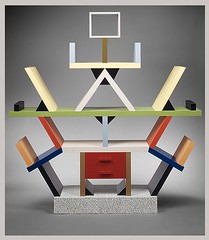
The Carlton Cabinet - Designed by Ettore Sotts...Image by Mario Seekr via Flickr
Bookshelf, Ettore Sottsass, 1981

The holiday season tends to bring out the kid in most people. And when I think of kids and design, I'm most reminded historically of one of design's more unusual and whimsical periods - that of the Memphis style movement.

Primarily begun in the 1980's as a product design statement by a group of avant-garde Italian visionaries, including the acclaimed industrial designer Ettore Sottsass, Memphis style went from being shockingly esoteric to the mode du jour in less than a decade. In doing so, it challenged many of the long-standing rules of design, and brought with it a new era of post-modern experimentation and vitality.

The New York Times documented the beginnings of the movement in a related MoMA exhibit review a few years back:

Typwriter, (Valentine), Sottsass, 196
"Memphis was cooked up in Ettore Sottsass's Milan apartment one night in December 1980, when the host, then in his sixties and a grandee of Italian design, invited a group of younger designers to develop a furniture collection to show at the following year's Milan Furniture Fair. It was to be a protest against the dry modernist style that had dominated design for decades, and they called it "Memphis" because Bob Dylan's "Stuck Inside of Mobile with the Memphis Blues Again" was on the record player, and the needle kept sticking (a common problem back in ye olden days of the 1980s) on the last three words of the title."

Some say that Memphis design also put an imaginative spin on Art Deco style of the 1920's, the later of which derived much of its initial influence from Egyptian motifs made popular at the time by the discovery of King Tutankhamen's tomb. Hence, the name may play on that foundation as well.

Whatever the case, the movement's bold use of bright primary colors and expressive zig-zag patterns seeped into everyday 1980's fashion and can be traced essentially to Sottsass's vision. The colorful triangular shapes on the pop singer El Debarge's jackets, or the the striking yellow outfits Mick Jagger wore at the time come forefront to memory. The movie Ruthless People, with Jagger's voice commanding the animated intro, gives one a good glimpse of the true playfulness of the style, as shown in the clip below:


But it was more than just color and wit that comprised the sensibilities inherent in Memphis design. There was a clear repudiation of standard assumptions of proportion and shape that stretched a new canvas for creative possibilities. Many of these overturned notions are present in product designs of items such as Apple computers and iPods, giving them an almost perennially futuristic appearance.

Sottsass also experimented heavily on a "utopian" concept of living space. He was an opinionated anti-consumerist, declaring at one point that "I didn’t want to do any more consumerist products, because it was clear that the consumerist attitude was quite dangerous."


"Living Environment" Exhibit, 1972.

Thus he often detoured from furniture design to explore concepts of interior and architecture. His forward-minded "Living Environment" exhibit, consisted of a series of nine compact, modular living compartments, each meant to be easily personalized and pleasant. One compartment contained a kitchen, another a seat/bed, a wardrobe, a toilet, a desk system and even a jukebox. His compartments were all connected to provide water and electricity to each unit.

As we move along into the twenty-first century, our living space is shrinking. In big cities such as Tokyo and Shanghai, his concepts already exist. At the rate we are depleting natural resources and contaminating the earth environment, there may well be a need for all of humanity to live in separate, small, sealed rooms that share power and water.

Totem Vase.
But in terms of mere aesthetics, some claim that we are in the midst of a Memphis style renaissance. As stated nicely by the Times reviewer, recent style is "rebelling against the slickness of megabranding to chase the 'emotional and expressive' qualities in the original Memphis pieces," and design also seems to be "searching for alternatives to the delicate neo-romantic style, which was fashionable in the early 2000s." What could be more suited for that than a reinterpretation of kitschy, flashy Memphis?

Love it or hate it, Memphis style remains one of the more peculiar and startling moments in design history. It was an eruption of modernity, as if modern style were looking back and re-imagining itself as a vibrant, amusing, radical, self-aware, contemplative other face. And as Sottsass said in a 1986 Chicago Tribune interview, "Memphis is like a very strong drug. You cannot take too much. I don't think anyone should put only Memphis around - it's like eating only cake."--D.A. DeMers.


For helpful information about weatherization and home energy issues, please visit our sister site Home Science. Plus, stay updated with tons of fun posts on art, design, and sustainability, by hitting the Tumblr and Twitter buttons above.
Enhanced by Zemanta

Tuesday, November 9, 2010

The Origins of Flight

A young man's unlikely ascent into the world of design   
           
Image via Wikipedia
Not long ago I was looking through an old magazine and out plopped some photos of lamps I thought were long lost. There's a story linked to them worth telling, so here goes...
              
Wicker Park Chicago in the 90's was not unlike Greenwich Village in the 60's. The cafes, lounges, and parties resonated with the constant chatter of creative ideas. Music, art, literature, and youth culture had converged on this locale, and in the air was a tremendous zeitgeist shared by everyone, a sense that something quite amazing was happening...and things did.
   
That's all over now. And I have exiled myself to Philly, where that same spirit of creativity is beginning to burn brightly (and likewise so does the spirit of championship baseball team). Wicker Park now seems nothing but a faraway planet of unauthentic-looking chain bars, ubiquitous trendy restaurants, and stretches of hastily slapped together yuppie condos. Dorothy Parker's famous quote is fitting: "there's no there there."
 
But for one particular moment in time, it was a special place. And being one who experienced the apex of that moment, I was motivated to do many artistic endeavors. Playing music and being in a variety of bands was one, but more offbeat, perhaps, was the compulsion to make things, especially lamps.
    
It started with an odd curiosity and study of the "birdmen" who built flying machines in the early 1900s. They seemed particularly fascinating, since many of them had no prior experience with such engineering, yet risked death to see if their contraptions would succeed. The human desire to fly is a legacy steeped in mythology, linked back to humankind's first ambitions. It's the consummate metaphor for freedom on many levels - the dream to defy the shackles of gravity, whatever that may represent...I often felt that gravity profoundly.
   
When electricity became usable to consumers, many designers, engineers, and architects found an alluring new technology with which to work. From the Arts and Crafts era to Art Deco, a plethora of imaginative lighting designs were created, designs that greatly influenced my flight into this enticing realm.
   
The French-based Desny design group and lamp artists such as Kola Moser of the Austrian Weiner Werkstaette offered some of the more compelling lighting treasures, utilizing crome and glass in ways that explored their dazzling reflective and refractive properties. There's a magical sense working with an object that emits light that one doesn't quite feel when making a chair or table.
  
    
I was drawn to that magic with a child's sense of wonder. I did everything possible to learn how to make such fascinating objects. I learned welding, silver-smithing and jewelry-making, studied design from every aspect, and in 1995 opened an art metalwork and lamp shop called Birdman Studios in the flat-iron arts building at the corners of Milwaukee Ave., North, and Damen - the heart of Wicker Park.
    
I used whatever materials I could find - reclaimed gas pipes, old cast-iron fittings, discarded sheets of copper, steel, or aluminum. I experimented with all types of glass, then mica, plastic, whatever. So obsessed had I become with these luminous creations that friends seemed more than a bit concerned. I had transformed into, well, a "birdman".
   
It was difficult to explain how personal these projects had become - they were like my offspring. I recall one crowning moment, an exhaustive late night when I sat back in that little urban studio, sweat and grease smeared across my brow, and gazed at the warm, glowing spectacle of my family of little lamps. I gave so much of myself to making them, and they gave back such a satiable sense of fulfillment and magic...yes magic. I never wanted to let them go.
     
However, economics is often a buzzkill for artistic passion, and so my wife Anne and I eventually schlepped the creations to gift shows, art fairs, community events, held open studios, did anything and everything to make a living selling those things. Finally I was picked up by an artisan rep who schlepped them for me, and to some very prominent home furnishings and gift shows in New York, Chicago, and Atlanta. Soon enough the lamps found proper homes in museum shops, including New York's MoMa, the Walker Center in Minneapolis, and Chicago's Museum of Contemporary Art.
      
It was quite an unlikely roll of events from there on. One day I got an offer from a major international men's lifestyle magazine to be featured in their series on "cool" lamps. It's still a mystery as to whether my studio was the original intended destination for the reporter's inquiry or whether the lead was actually meant to be for somebody more notable down the hall from me. So be it, fate is a funny thing.
    
In any case, I was the lucky benefactor, and they chose my sculptural hand-forged aluminum "Moonstation" lamp to be featured in the magazine, juxtaposed with an assortment of non-alike creations by other makers. That exposure, along with a linked mention on NBC's Today Show, would change everything. I received an influx of calls for orders - more than I could possibly execute on my own. Desperate for resolution, I approached a local lamp manufacturer about the possibility of getting them mass-produced.
        
Instead, I wound up becoming a product designer for the lamp company and for the next decade designed lamps and furniture for some very big retail stores, including Lowes, Target, and Pottery Barn, and in doing so, traveled the world like Marco Polo from China to India to Paris - a mission this humble, small-time lampmaker who began from a tiny studio in Chicago found impossible not to undertake.
    
I never returned to making one-of-a-kind lamps by hand, something I regret as the years roll by... Perhaps someday, though, the Birdman will fly again.


Above is a page from the March 1999 issue Maxim Magazine that featured one of my lamps. Below are pics I recently found of some of the handmade lamps of the Birdman Studio years 1995-1999. I believe friends still own a few of the firsts.


Enhanced by Zemanta

Friday, July 23, 2010

Splendor in the Grass


A few of my recent posts have been a tad bleak, noted by grim topics about tough economic times and pressing environmental issues. A friend mentioned that even listening to Joy Division songs cheered him up after the reads...

So let us take a little summer break. Let us free our minds and go to a soft, fuzzy place. I'm imagining a 70's style movie clip - a close-up of a sun drenched daisy field, followed by a zoom to a mod-styled Jane Birkin and Serge Gainsbourg strolling gently in the distance to the sounds of easy grooves. Then later in the evening, glasses of Riunti wine are clinking in front of a glowing fireplace, shag rug and all.

Fast-forward a few decades and you'll get that same hip, fuzzy feeling at Grasshopper, a fabulous chic boutique near Philadelphia's Old City area, with all the latest fashions for the new generation of Jane Birkins and Serge Gainsbourgs.

Grasshopper Boutique
The stylish apparel and accessory shop, which is in its 4th year of operation, is the creation of Tracy Lutz and Regina Louise, two young ladies with an amazingly keen and playful fashion sense.

In addition to offering forefront designs from labels around the globe, the shop also features items from an assortment of talented local designers and fashion artists, such as Magic Outlaw apparel by a team of young entrepreneurs at Philadelphia's own Outlaw Printing Company.

Buying from area vendors, or being a locasumer, not only helps the local economy, but can be another small way to cut down on carbon emissions and help the planet (see my post The Art and Soul of Philly). It also puts you at ease knowing that your clothing wasn't the output of some slavish sweat-shop somewhere overseas.

Both Tracy and Regina both met while working at a swank t-shirt design company here in Philadelphia, and though neither were of formal fashion design education - albeit Tracy already had experience in the industry as a fashion model, and Regina worked in the design department at fashion-loaded Urban Outfitters, which is headquartered in Philadelphia - they shared an intuition for style and love of clothes, and decided that opening their own "supertique" would be an ultimate fantasy come true.

Much of their inspiration can be found at their visually dazzling blog Come Spy With Me. But be careful, you may be forever lured into an intriguing world of fashion espionage.

The two ladies also seem to have an uncanny eye for interior design, especially 70's style, evidenced by the hard work they've done on the store's great decor. The walls are decorated with colorful mylar floral and photo prints, the crystal lighting fixtures give a neo-baroque sense of elegance, and the lipstick red metal fireplace and bearskin rug near the dressing rooms adds sexiness and warmth, literally - the wood-burner is their main heat source.

Cheers!
Tracy says she loves to collect items from the '70's because it reminds her of childhood and that she feels like it was a fun decade. She has wonderfully decorated the walls of the store with the numerous super-groovy paintings and drawings of the era that she has collected throughout the years. It gives the space a very personable, but hip feel.

"I didn't want this to be just another vanilla box," she says, referring to standard white-walled boutiques and galleries that house clothes and art. "I wanted the space itself to be art."

Based on the looks of their Grasshopper Boutique, they've made that happen in a fun and beautiful way.--D.A. DeMers.


Ballade de Melody Nelson. Classic hit song by Serge Gainsbourg.


--------------------------------------


Grasshopper co-owner Tracy Lutz.

Cozy mod.

Grasshopper's interior with vintage owl wall art.

Grasshopper's interior - vintage photo wallpaper

Accessorize yourself!

A celebration last year at Grasshopper's 3'd anniversary.


Note: This article is an update from my earlier post last September.


Coming soon to designer in exile - the magnificent landscape design of Chicago's Botanic Gardens. Would Daniel Burnham be proud? And be sure to visit my new site, Home Science, for professional energy saving advice on your digs.


Enhanced by Zemanta

Tuesday, July 20, 2010

Dwelling On Sprucing Your Dwelling? Thrifty Tips.


Decorating on a budget.
The conventional wisdom that apartments should be minimal, temporary-looking spaces is in no way an absolute - they can easily be made to have the feel of a well lived-in home. Apartment living is a great way to save money and allow for freedom of mobility. Sprucing up your abode cheaply will brighten your mood when you have guests, or simply let you enjoy it better on your own. Here are some ideas and resources to help decorate your apartment nicely on a budget, while also reducing your negative impact on the environment.

Sales and collecting: Yard, garage, and discount stores are the best place to find home furnishings for cheap. Furniture, wall art, and storage items don’t need to be bought brand new. You can find beds and couches and revive them with mattress covers and slip covers. Décor doesn’t even have to be purchased. Do you collect classic vinyl records, movie posters or have a collection of vintage bottles? Why not use them as décor in your apartment? Put them on display walls, in shadow boxes, or on a shelf to bring instant personalized home furnishings to your apartment. You will be surprised how collections can be an innovative focal point for a room.

A friend of my wife was on the Today Show this morning because she represents ranks of people called "hoarders." A lot of Americans seem to be holding on to sentimental things more today than ever, and not necessarily as the result of some newly declared nationwide neurosis. I use more sensitive sounding terms like "enthusiast," or "preservationist," or "collector" to describe them, especially since I'm married to one.

Websites and classifieds: Websites like Craigslist, Backpages, and other free online classifieds are a great resource for finding home furnishings. Not everybody can hold on to belongings these days. People are often moving out of their homes and need to get rid of items fast and cheaply. Here in Philly, one can find online "swap" groups like Philly Freecycle, which is part of a nationwide Freecycle Network started in Tucson in 2003 to promote waste reduction in Tucson's downtown and help save desert landscape from being taken over by landfills.

Other resources such as Estate sales are published in online classifieds as well. Estate sales often sell items from someone who has passed away, but they can also be from those who can no longer financially afford their belongings. Take advantage of these because you may discover one of a kind bargains.

The diy planet: It's quite likely that you and some friends may be able to assemble anything you put your mind to. Do it yourself tables, chairs, and entertainment centers can save you money. Ikea, for example, has décor and storage ideas for every budget, and every assembly skill level. They also claim to be eco-friendly because they use a certain amount of recycled materials and less toxic binding agents.

But if you're truly interested in saving the planet's dwindling resources, keep in mind that it requires energy to recycle, so the idea that a cheap, toss-away, recycling culture will get us all off the hook from further degradation of our environment is somewhat misleading. Recycling is good, but Re-use, re-appropriation, and swap is my recommendation, whenever possible. I often shop for antiques, vintage pieces or go to thrift stores, I bring my own re-usable cup to the coffee shop, and use an aluminum water bottle over recyclable/disposable plastic ones... Perhaps, someday, we'll see the return of the milkman and his refilled glass bottles at our doorstep, just like on Leave It To Beaver.

Nicely balanced palette of blues, browns, and neutrals.
To acquire pre-owned furniture, vintage shops like Vintage Modern here in Philadelphia offer a great assortment of quality home furnishings that haven't hit the often pricey 100-year antique mark.

If you prefer something new and can afford more than the Ikea variety, consider investing in furniture that will last for generations - I still utilize my father's beautifully crafted, hand-me-down Eames era desk from the 1950's. Places like Pompanoosuc Mills with its local showroom in Manayunk are great examples of new, built-to-last furniture - and their prices are not off the charts. They make good solid wood pieces, custom made from Vermont Forest Stewardship Council wood sources. They've been at it since 1973, and green before the term was ever conceived as a marketing ploy.     

Add and coordinate color: A fresh, nicely thought out color scheme is likely to give to the most prominent indication that you've done a makeover. Adding color to your apartment with bed and bath accessories can change the atmosphere immediately. Coordinating bed linens, curtains, and an area rug can pull together a dull space with minimal effort and expense. Matching towels, bath rugs, and shower curtains will help you feel and look good in your bathroom.

Ikea space saver.
Efficient use of space: If you're downsizing from a larger space, or taking on guests - a reality of these tough economic times - there are several ways to help make the best use of those spaces. Loft beds are a cheap way to accommodate several people in a small space. Loft beds are reminiscent of bunk beds, which take advantage of vertical space. The items can be bought at furniture stores, garage sales, or check college dorm and apartment bulletin boards for quick sales. Even if you don’t have a lot of people in your apartment, the beds can be utilized to straddle a desk area beneath to save valuable space in your bedroom.

Under-bed storage and multi-purpose furniture, such as sofa-beds, or coffee tables that expand and convert into office desks, with filing chambers and more, are great for small space situations. And many of these can be found at affordable stores such as Ikea. A nice series of convertible coffee table/desks is sold through local American Signature Furniture stores.

Likewise, while visiting my mother recently in Chicago at her quaint, efficient condo, she demonstrated how her sunlit kitchen table could easily become an improvised office desk, when needed. This I found especially beneficial because it allows natural light onto the workspace, and brings the office into a generally uplifting environment - the hearth. It also solves the problem of her traditional office desk, as beautiful a piece of Chippendale style furniture you could imagine, from facing a blank wall. She prefers the kitchen table instead because it allows for a variety of seating focal points from which to choose.

There was a time when designers often drew distinct boundaries between eating, sleeping, and work environments. To some degree, events of the last few years have made us rethink those psychological aspects of space planning and proxemics - at least I have.

With the use of the right resources for quality items one can decorate an apartment without having to peel off a lot of Ben Franklins. There is always someone moving in and out of apartments and homes, perhaps more so than ever. These tough times have created many money saving opportunities and resources, as ironic as that might sound. You might as well make use of them to help your wallet and help the environment at the same time.--D.A. DeMers


Coming soon to designer in exile - the magnificent landscape design of Chicago's Botanic Gardens. Would Daniel Burnham be proud? 

And be sure to visit my new site, Home Science, for professional energy saving advice on your digs.


---------------------


Image credits: Top dining room, share alike license, owner does not necessarily share opinions on this page. Classifieds, share alike license. Craft room, share alike license, owner does not necessarily share opinions on this page. Contemporary room, share alike license. Loft bed, share alike license. Ikea, share alike license. Eco-smart dining table, share alike license.

Enhanced by Zemanta

Wednesday, April 21, 2010

Wanted and Dangerous: Designer for the Mob

alvar aalto furniture study model 03Image by seier+seier+seier via Flickr

I should have known by the t-shirt he was wearing when he walked in the door. "Philadelphia Homicide Squad," it read. I asked him if he were a police officer. He starred me down with a sarcastic eye, glanced at his elderly father and with a crooked grin said "yeah, right. Homicide is my specialty."

It was my first year at my new job in Philadelphia. I had spent most of the previous 10 years working as a product designer for a Chicago-based importing company, designing lamps and home furnishings for well known American mass-market retailers. I had traveled Asia like Marco Polo, sometimes flying there 8-10 times a year, an occasional trip to Paris, London, India. I lived in extravagant five-star hotels. It was the life of a rock star...perhaps even better.


But in the end, it was all too much. I was everywhere, but nowhere. Always on the go. I had lost a sense of community, and missed the simple things we often take for granted, like going to movies with friends or just casually hanging out with family.

I also began to think a lot about what I was doing and why. I began reading books about the environment and our changing world. About human rights and labor issues. Globalization wasn't exactly working the way President Clinton made it sound like it would. And we really didn't seem to be advancing as a species or as individuals - least not me.

Don't get me wrong, I believe in the virtues of a free market system, competition, and hard-nose capitalism. But as time wore on, I began to witness many things overseas that contradicted those notions, things that required me to look away. I was getting paid well, and living like a king, but I felt a terrible weight building on my shoulders - my own Myth of Sisyphus, an existential crisis. Depression deepened the darkness of my eyes. It was time to change my life. I knew I had to simply walk away from it all.

I moved to Philadelphia in early 2007. I sought out a job as a custom furniture designer for a small Vermont-based solid wood furniture maker with a showroom in Manayunk. It was a true "green" company, and one with high ethics. Instead of traveling across the globe 10 times a year to an industrial purgatory to inspect lamps destined for the landfill a few years after purchase, I would take train rides up to a little mill in bucolic Vermont to review beautifully handcrafted furniture made from Forest Stewardship Council wood sources, and built to last a lifetime. I had reduced my carbon footprint from the size of Sasquatch to that of an ant. True, I had traded a nice salary and amazing perks and was now living on very modest means, but the important thing was, I got my soul back...well sorta...


That brings us back to where this story all began. I soon realized that the gentlemen who walked into our lovely Manayunk showroom that afternoon were probably not typical clients. The name was too familiar. It was just a hunch, but after a quick google check, it occurred to me that they might actually be affiliated with an infamous family known to Philly in a Sopranos sort of way.


Now keep in mind that the serious mafia wars in this town had long since ebbed from the days that Nicky Scarfo went on his murderous rampage, which included a series of bomb blasts that went off when his enemies turned on the ignitions of their cars. But I still felt a tad uneasy working with these fellas. Possibly it was the thought of being labeled designer for the mob! Would my picture be on an FBI sheet at the post office along with mob accountants and bookies, just like in the old movies?

Nonetheless, money was tight and I really needed the sale, so I pushed that thought to the back of my head and began working on some sketches for the guys. We ended up with a nice ensemble of transitional, Danish modern styled pieces. The wood selected was a light stained birch, and they choose a Merlot chamois fabric from Robert Allen for the upholstery. Discussing fabrics and fashion trends with mob bosses was something I never quite anticipated in design class. But hey, life is full of surprises.

The consultation was without issue. I recall the elderly man say something like "I like this guy, he's good." They even invited me to their residence to offer interior design advice. As weeks went by prior to delivery date, "the Godfather," as he was referred to by others in the family, phoned me continually for advice on arbitrary matters - like how to remove mysterious stains from seat cushions. He seemed to have a lot of accidents.


I didn't worry much about completion of the deal until one day I checked the mill's production list and realized that a slip-up had occurred - no work had been done on the order nearly 10 weeks after being placed! Soon I started getting calls from various members of the family concerned that something had gone wrong, that maybe I hadn't "handled the job right."

I began to sweat. I had nightmares of being rolled in a rug and tossed in the Schuylkill river - mind you it was an exquisite hand-tufted wool rug, custom designed, imported from Nepal. I had designed several of the kind already. The quality of Himalayan wool is unbeatable, and the workmanship on the rugs is excellent. I highly recommend them.

In any case, I immediately got on the phone to Vermont and explained to those laid-back New England hillbillies that this was Philadelphia. Things happen differently down here, I said. "People can get very upset when stuff doesn't go as planned."

I pleaded desperately for my life, and finally got them to push the order to top priority.

The customer's furniture was only delayed by a few weeks. I'm guessing it really wasn't such a big deal to them, though possibly just enough for the family to lose trust in me as their chosen designer for the mob, which was a good thing, of course, in my mind. I really didn't need another moral crisis in my life... I never heard from them again.

However, I do, on occasion, still get a little jittery when I turn on the ignition of my car.--D.A. DeMers.


Reblog this post [with Zemanta]

Tuesday, March 16, 2010

How Does Your Garden Grow?

RoseImage by vincent.limshowchen via Flickr

I wanted this post to be about rose bushes. Mostly about how to prune them so they will bud and blossom nicely in the coming weeks. If they don't get pruned and untangled from constraining vines, they may wither and die, which is a shame because roses seem to hold a key to our aesthetic, intellectual, and spiritual satisfaction. Pruning them gives me, in some measure, a great sense of hope for the future.

But as I started writing, I noticed something strange. I clicked on my internet feeds and saw that one of them no longer existed. It was the "green news" link to a major furniture industry trade publication. The journal is essentially the Vogue magazine of home furnishings, and one that virtually commands the direction of the industry. What's more, they have been part of a media conglomerate that owns a vast array of websites and publications related to the furniture industry and building trades.

That's a mighty powerful position to be in.
 
I looked deeper and noticed that nearly every reference to environmentalism had been purged from the entire database. It was Orwellian, as if I'd awakened to find the word democracy erased from the lexicon - something that mysteriously happened occasionally while searching the internet on business trips to China.

This all seemed inexplicable, until finally I reached a blog post on the publication's site that contained a remarkable conversation filled with boardroom chatter from industry professionals. The comments were as follows: "The profit margin is simply not large enough for us to promote these (environmentally friendly) type of products," and "it's time we begin putting profits before earth." I was befuddled, not just because of the hard-line business talk, but because in reality, the profit margin for these products has been steadily trending upward. The outlook is quite bright.
 
A source affiliated with the media group, who asked not to be identified, affirmed my knowledge on this matter, saying that the eco-smart product marketplace is thriving and very profitable, but that there are people within the furniture industry with agendas and interests different from that of the sustainability movement.

The timing of this coincides conveniently with the current mortal storm of thought that is dismissing the theory of climate change. In fact, look at what some of the great emerging minds in the anti-sustainability world are saying here on this recent blog, with provocative notions such as "Earth Hour" shows "the environmental movement's distaste for modernity," in which a blogger seems to claim that the Earth Hour protest was an assault on the sanctity of the industrial world, electricity, and the economy. With astonishing sincerity and pathos, he essentially equates utility companies with freedom. The message seems to be "don't tread on my electric grid."

I challenge these misinformed contrarians to examine some common sense concepts about this "daunting" brave new green world. Sustainability is ultimately about upgrading the quality of peoples lives. It is about reducing inefficiency and is a methodology of logic and ingenuity that both gathers from and informs human intellectual and ethical progress -which includes economics. Despite occasional relapses, the human race tends to move toward this definition of progress.

At a recent symposium at the Academy of Sciences here in Philadelphia, giant corporations such as Dow Chemical and others discussed the new mode of sustainability in corporate thinking from the top down, in contrast to the more commonly viewed grass-roots perspective. Big players are beginning to see the green writing on the wall. Keeping their workers healthy saves money. Being less dependent on the petrol-chemical market and being more energy efficient saves money. To think otherwise is detrimental to capital investment and the survival of the free market, especially as energy rates soar and resources are depleted. Even Walmart, as recent as last week, adopted major measures toward sustainability.

This is not mere green-washing, this is the bottom line. Ironically, some of these companies have even been low key about their moves to become energy efficient and green, because they fear a backlash from the new anti-green mob that is rising like the ocean levels. And oddly enough, I find myself in the awkward position of cheering on some multi-nationals I protested against years ago who are now taking steps to change.

In the end, both grass-roots and corporate sides must converge and for all the right reasons to make environmental sustainability truly sustainable. But meanwhile, who's gonna tell a multi-billion dollar company like Dow Chemical or Walmart that they can't go green? And why fight them?

Some occasional pruning is needed for this movement, that is undeniable - just like with my rose bushes. That can only help. But it surely that doesn't mean it is bound to wither and die...

Funny how my mind wanders sometimes. And since this post has become as loaded with earthy metaphors as Chauncey Gardner, let us get back to where we started - helpful tips on caring for roses in your garden.  Here's some great advice from 5minute Videos. So enough of this gloom and doom, let your garden bloom, bloom, bloom! --D.A. DeMers.

                                                             --------------

(Update: all links to "green news" for the publication mentioned above have been recently restored. The publication is now under new ownership, and I have chosen to keep it anonymous since it is not the central focus of this post).

Image credits: Pink Rose Bush, Martha Washington, CC License 1.0 . Frank Gehry recycled cardboard chair, CC License 1.0. All others by D.A DeMers, and free to use under CC license 1.0.
 
Reblog this post [with Zemanta]